


By Vince Chong
SMU Office of Research Governance & Administration – Tightening energy security. Boosting aviation and maritime risk management and efficiency. Enhance urban and infrastructure resilience planning.
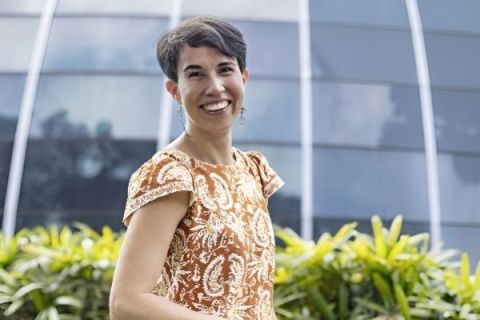
These are objectives that SMU Professor Fiona Williamson hopes to meet as she works on an ambitious Singapore-based multi-institutional project to reanalyse weather records for Southeast Asia (SEA) across 35 years between 1990 and 2025, under the Weather Science Research Programme (WSRP). This is the first time that a reanalysis study is done for this region, even though such studies are “standard” in other parts of the world, the project’s proposal noted.
As climate and environmental threats continue to rise, the resulting high-quality data set will be used to train artificial intelligence (AI) that will make even more precise weather forecasting in SEA.
“The types of data that we hope to uncover… will be able to feed into all different types of projects that urgently need better and improved data sets for weather modelling or reconstructions,” Professor Williamson told the Office of Research Governance and Administration (ORGA).
The benefits are multi-fold. Improved weather forecasting means SEA governments can plan for, say, a drier-than-usual climate in Laos that could affect hydropower supply to neighbours like Singapore, or a period of cloudier skies that might hit solar energy planning.
The aviation and maritime sectors will also be able to access details such as wind speed and direction in greater precision. This will boost aircraft landing safety, inform on best routes to minimise fuel consumption, or simply reduce adverse weather risks for staff.
“All of these areas are equally important,” Professor Williamson continued.
“Many are linked and cannot be considered in isolation.”
The environmental historian is one of the experts in the Maritime Continent Atmospheric Regional Reanalysis (MCARR) study, which has been awarded a grant by Singapore’s National Environment Agency under the WSRP Funding Initiative. The project, based in Singapore, will also reinforce the country’s National AI Strategy, and its leadership in regional climate resilience and smart weather forecasting.
A major step
One of the most “prominent” effects of the project is “the development of new capabilities and know-how,” the project proposal set out. These include executing and managing proper data quality control, as well as scientific analysis, and amplifying downstream applications for public agencies to, for example, tackle heat and flood resilience.
Current weather forecasting in Singapore, it noted, is largely based on a “deterministic ‘will it rain or won’t it’ approach.”
“However, decision makers require a more risk-based framework, combining a ‘probabilistic’ approach (likelihoods of rain of a certain threshold estimated) with assessment of impact,” the proposal stated.
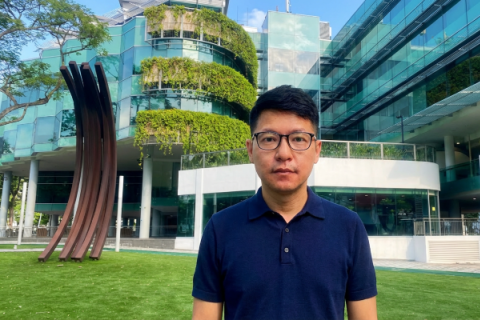
SMU Research Fellow Praveen Teleti, who is assisting Professor Williamson, noted that the MCARR “is truly a major step forward in regional reanalysis model evolution.”
Historical weather observations in SEA, for one, he explained, were constrained by available technology, with existing forecasting models restricted to coarse mapping resolutions from a distance of nine kilometres or more. By contrast, the MCARR team will attempt to reduce this resolution to four kilometres or less.
“This will pave the way for local and potentially devastating weather systems to be detected in unprecedented detail,” said the climate scientist. Such detail is crucial for understanding “small-scale processes” such as thunderstorms and convective precipitation – rains caused by a surfeit of warm air – which can cause flash floods that kill and destroy property.
The project is not without its challenges, a key one being finding and accessing weather data for SEA compared to other regions. This is a “big problem” exacerbated by a lack of resource in many SEA countries to preserve, construct images, and digitise such historical data that is kept in paper form, Professor Williamson said.
“First, there is the problem of data sharing amongst different SEA countries, which tends to be sporadic and dependent on data sharing policies of the country itself,” she explained.
“Second, and perhaps more importantly, is the level of data that is available in usable formats before the 1990s… Thus, even if a country was happy to share information, it may not be able to.”
Another challenge, as the proposal noted, is that while AI and machine learning (ML) have "emerged as revolutionary forces in weather and climate science," it comes with the risks of "degraded forecast skill" and "unphysical solutions."
As Dr Teleti explained, while ML models are being actively used in climate research, they might not be “learning” properly from expensive climate models whose forecasts typically take weeks or months to generate. ML meanwhile, could produce one in days.
“Hence without a properly reanalysed and refined climate model rooted in physical laws, some of the ML predictions could be outlandish, like negative precipitation, [or] too hot or cold temperatures,” he said.
The MCARR project, the proposal added, aims to “assess the potential hybrid physical-AI modelling systems to provide a better balance of cost and accuracy.”
New opportunities
Other key benefits attached to the project, the document added, include helping financial institutions in SEA such as banks and insurance companies better manage and price climate risks.
The same goes for building professions and government agencies developing urban projects in the region. With the project’s help, they will be able to better design, for instance, drainage or stormwater storage systems, to avoid “catastrophic failure of infrastructure,” while unlocking new applications with the help of AI.
In all, it appears to be an exciting time for weather experts in the region, whose area of work has long caught the imagination of the public, for example, through big-budget disaster movies.
Most of which, Professor Williamson said, make her “irritable” for their unscientific presumptions. She does however, support movies that are “important for better communicating to a wide audience the need to do something about climate change on individual, community, and national levels.”
Finding better data and improving the capabilities of tools to be used to study climate change might not fetch obvious benefits in everyday life, she said, but “they are of utmost importance in the region of planning, mitigation, and sustainability.”
Back to Research@SMU February 2026 Issue
See More News
Want to see more of SMU Research?
Sign up for Research@SMU e-newslettter to know more about our research and research-related events!
If you would like to remove yourself from all our mailing list, please visit https://eservices.smu.edu.sg/internet/DNC/Default.aspx