

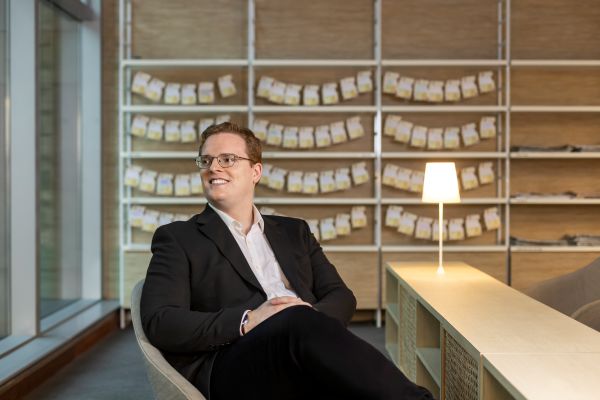
By Christie Loh
SMU Office of Research Governance & Administration – A sleek seagull that cuts through sudden headwinds.
That is how Assistant Professor of Computer Science, Jonathan David Chase of Singapore Management University (SMU), describes the optimisation model he has developed using Artificial Intelligence (AI) for the procurement needs of technology giant IBM. Be it war-disrupted factory output or COVID-19 lockdowns in China, the sophisticated computer programme can adjust the company’s supply chain accordingly – and in a cost-saving manner.
Under a project funded by IBM, Professor Chase worked with the Principal Investigator, SMU Professor of Computer Science Lau Hoong Chuin, to tackle the supply chain challenges of IBM Manufacturing Solutions. Their design resulted in a paper, “Multi-period risk-aware procurement optimization under COVID-19 disruption”, published in October 2025 in academic journal Transportation Research Part E. Their data-driven model is an enhanced iteration of what they first developed for IBM in 2022, which sought to create a procurement strategy that could meet general risks such as natural disasters or labour disputes that affect operations and customer timelines.
The enhanced version worked in two stages. It collated and analysed historical information on how various cities in China – a major supplier for businesses worldwide – dealt with COVID-19 outbreaks, and identified patterns in areas such as how long a supplier is disrupted by a lockdown. At the same time, the model calculated risk scores for each of IBM’s suppliers based on their operational impact from a COVID-19 outbreak. Both components then worked together to generate a cost-effective, risk-resilient procurement strategy.
The result is pleasing to the bottom line: The new optimisation model can outperform the first model by up to 50 percent of the expected cost when exposed to COVID-19 lockdown disruptions.
IBM had managed to save US$1.8 million in their hard disk drive commodity category within a year of deploying the first optimisation model that SMU developed, and projected that they would save US$35 million annually across their Infrastructure operations globally. So successful was the academia-business collaboration that IBM won an industry award in the United States in 2023 for its digital supply chain accomplishment; the company has also integrated the model into its Cognitive Supply Chain Advisor 360 solution, an optimisation tool sold to corporate customers.
Man aided by machine
In terms of manhours, Professor Chase’s AI-powered system made equally impressive savings. As opposed to the old, time-consuming process of IBM staff making calculations manually, the computer system literally takes just minutes to develop a procurement strategy taking into consideration worldwide data such as rebates offered by a supplier in a particular country for specific computer parts.
“The capacity of the decision model to generate solutions rapidly across the gamut of parts led to rapid uptake among procurement teams around the globe, as even with the time-zone delays, the speed of the model was superior to the previous approach,” said Professor Chase.
“You can have a procurement team that may be very good at making judgments, but individual people are always limited in how much they can see,” he explained in an interview with SMU’s Office of Research Governance and Administration (ORGA).
“An optimisation model allows you to put the whole picture into the model and generate a plan. The savings come from looking at everything together and then the risk analysis element comes in to make sure that as you’re saving cost by doing things more efficiently, you’re not compromising your risk resilience.”
Working data provided by IBM Singapore showed that the COVID-resilient optimisation model had “real-word viability”, he said.
Planning for the next ‘Black Swan’
While the global fallout from the COVID-19 pandemic may have faded from memory for many, the so-called “Black Swan” event spawned valuable lessons and data for “future planning” in supply chain risk management, said Professor Chase.
The development of a COVID-resilient optimisation model provides a kind of framework for procurement planning when there is a risk of supplier shutdown, he said. Should a new pandemic arise – which, he added, was not far-fetched given the increasingly inter-connected world we live in – the model can customise the “set of rules and values” drawn from the COVID-19 experience to align with fresh data coming from the new pandemic. “So rather than having no idea how to tackle a problem, you go, ‘Well, this is going to be my starting playbook and I will modify it as we go along.’”
He likened the model to a seagull that can fly in a storm: “The seagull doesn’t have to predict where the wind blows from, but when the wind blows more strongly than expected, it’s able to ride it, not fall out of the sky right away.”
Indeed, a well-designed AI-based optimisation model can be adapted for use in fields beyond business, said Professor Lau.
“Procurement strategies at a national level are essential,” Professor Lau wrote in an article published in March 2024 in SMU’s Asian Management Insights. “Decision-makers, be they in private or public organisations, would do well to invest in such capabilities before the next Black Swan event hits.”
Back to Research@SMU May 2026 Issue
See More News

Want to see more of SMU Research?
Sign up for Research@SMU e-newslettter to know more about our research and research-related events!
If you would like to remove yourself from all our mailing list, please visit https://eservices.smu.edu.sg/internet/DNC/Default.aspx