

By Vince Chong
SMU Office of Research Governance & Administration – Teacher. Lawyer. Sustainability champion. And now the Associate Dean of Research (ADR) at the SMU Yong Pung How School of Law.
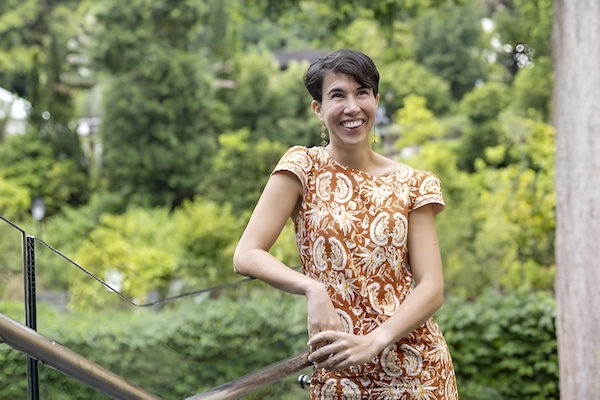
Meet Associate Professor Michelle Lim, for whom the aforementioned roles are well earned, and much cherished. If only, she said, she could fast forward time, and bed in faster, to better cope with the rush of new challenges.
“It is, without a doubt, an honour to be handed such important responsibilities, even if it is definitely more stressful!” Professor Lim told the Office of Research Governance & Administration (ORGA), citing, for example, the exponential increase in the volume of emails that she now receives.
“I'm certainly looking forward to not being so new at this.”
She likened it to “teaching a course outside your own expertise for the first time.”
“At the moment, I often am dealing with tasks that I didn't know I had to do. These frequently need to be delivered within short timelines,” she said.
“Just like when you teach a course the second time around, then you know in Week 1 what is happening in Week 4, [or] Week 12 even. It will be nice when, for this role, the entirety of it becomes more familiar, so I can step back and take a more strategic, birds-eye view.”
Embracing the opportunity
Being ADR is not in fact her only new role in 2026. Earlier in March, Professor Lim was also named SMU's first UNESCO Chair in Sustainability Law Futures. This puts her, along with the institution, at the forefront of legal research and policy innovation for sustainable development in Asia-Pacific.
At the same time, she continues with her own research and a “slightly reduced” teaching load that includes a master’s course this semester. But while she wished she had more time to focus on these commitments – in her email response to this writer, she attaches a “glum” emoji at this point – Professor Lim very much appreciates the opportunity to contribute to the School community and to play a larger role in pushing SMU further to the fore.
“It has been very insightful, nevertheless, to see how research strategy works at a different level,” she said.
“I often compare it to playing a sport and then also having experience as a referee. You see the game from very different, yet interesting, perspectives and gain a new appreciation of things you might not have noticed before.”
In addition, much of her work, at this current moment, is on “rallying the troops to contribute to the QS ranking exercise – while not losing sight of the main prize: producing world-leading scholarship.” She was referring to the Quacquarelli Symonds system that ranks tertiary institutions across a gamut of indicators.
“There are a range of targets we aspire to,” Professor Lim said, gently dismissing the suggestion that she has key performance indicators to meet as ADR.
“I'm not sure if I would call them KPIs; it's not as cut-throat as it sounds. We have a beautifully collegial environment at the law school. My key aim is to continue to build on research excellence but also on research environment and community.”
To overextend a football analogy, she continued, “it’s also like changing position from striker to playmaker.”
“So rather than focusing as much on scoring myself, I need to shift focus to getting the team to net the most goals possible.” This includes shepherding the law faculty to publish in top journals, and winning funding for research.
“There is also an element of bridging University level strategy to what makes sense for our particular discipline,” Professor Lim said.
“It’s been really interesting to see what approaches other schools are adopting, and to be able to share that with Law School colleagues.”
She names Associate Professor Bernadette Richards as a mentor and role model when she was a lecturer and researcher at the University of Adelaide law school between 2017 and 2020. Professor Richards was then ADR of the law school at the institution, which has since merged with the University of South Australia to become Adelaide University.
Fortuitously – in “our wonderfully interconnected world” – her mentor is now an external research fellow at the SMU law school, and well placed to offer advice. Which was simply to “just help everyone!”
“That has been the most meaningful guidance I've received,” Professor Lim went on.
“On the one hand, it was quite moving to realise that, when at Adelaide, Bernadette was helping everyone [and not just me]. At the same time, this advice provided a sense of clarity of purpose in my current role.”
Professor Lim also cites her predecessor Professor Maartje de Visser – now Associate Provost (Research Governance) – as a key source of support.
“Being able to go to Maartje on all questions, big or small, has also made a huge difference in navigating these new responsibilities,” she added.
Continuing research
In terms of her own research, Professor Lim is continuing to develop work that engages creative approaches – “for example, theatre, art, fiction, poetry” – to “explore possibilities for sustainable legal futures in a world of disruption.”
In July, she took a graphic facilitation class and is “excited about incorporating skills from that into teaching and into research leadership.” Graphic facilitation refers to the usage of visual images to express ideas and convey information. Which explained the emoji.
Professor Lim sees the tool as “an escape and attempt to prove what humans are capable of, while remembering the uniqueness of what it means to be human.” This encompasses the ability to create and feel, even when the topic at large might appear to be heavy and dry.
It sounds like interesting research but with Professor Lim’s increasingly cluttered schedule, would she perhaps wish she had more than 24 hours a day?
“No, please don't give me that as it will just mean I will have to spend more of those hours writing emails,” she replied.
“Just give me more hours to sleep, run, read and write!”
With that, she ends the interview with another emoji: a smiley.
Back to Research@SMU November 2026 Issue
See More News


Want to see more of SMU Research?
Sign up for Research@SMU e-newslettter to know more about our research and research-related events!
If you would like to remove yourself from all our mailing list, please visit https://eservices.smu.edu.sg/internet/DNC/Default.aspx