
By Christie Loh
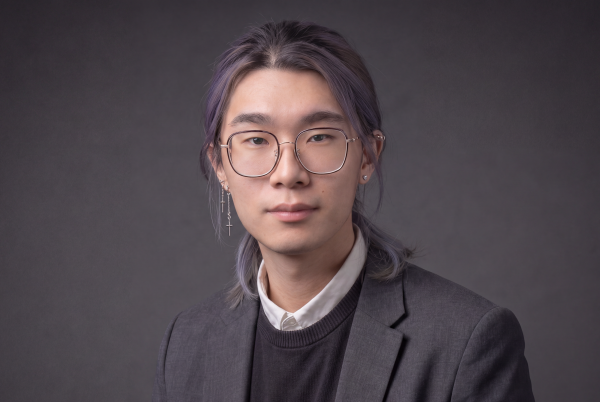
SMU Office of Research Governance & Administration – With his long ponytail dyed lilac at the tips and his dangly silver earrings, Dr Shi Jieke looks nothing like his staid photo from 2021 when he came from China to join Singapore Management University (SMU) as a Research Engineer. His current look is part of a personal mission to spice up his self-declared “boring” life as a researcher in Software Engineering. Yet his life captured on paper is anything but plain or dull.
In his five years in Singapore, the 27-year-old has published several award-winning research papers, completed his Doctor of Philosophy (PhD) in Computer Science with SMU in March 2026 and, shortly after, received word that he was one of two SMU recipients to have won a Postdoctoral Award from Singapore’s National Research Foundation (NRF) this year.
“I feel very surprised,” the soft-spoken Dr Shi said when asked about his multiple prizes.
The NRF award provides him with up to four years of funding for independent research, while another significant prize – the SMU Research Staff Excellence Awards 2025 – recognises his prolific publication of papers related to Software Engineering and Artificial Intelligence (AI), many of which are frequently cited, and his success in garnering competitive research funding, including support from the OpenAI Researcher Access Program.
‘Greening’ AI coding models
“Doing research and writing papers is like a hobby to me,” said Dr Shi. “I love the moment when my paper gets published.”
There is also the bonus of being invited to a conference overseas to speak on the published paper. In July, he would have gone to Montreal, Canada, to present his lead-author paper, “Compiling Code LLMs into Lightweight Executables”, but was unable to attend in person because of visa difficulties. Still, he was happy to deliver a remote presentation at the top-tier ACM 34th International Conference on the Foundations of Software Engineering.
Dr Shi’s latest paper sets out how he has managed to shrink large AI models that write code – think: the technology behind ChatGPT and Claude, which runs on expensive and energy-guzzling hardware in the cloud – into compact, lightweight versions that can run offline efficiently on personal devices such as common laptops. This would solve a huge headache for software developers who are thus far tethered to the office workstations because their own laptops lack the hardware to run the large models, besides the fact that their companies prohibit them from sending sensitive or proprietary code to external servers.
With Dr Shi’s developed framework, which is named DITTO, software developers will be able to run large language models on their laptops. Feedback from early users in the coming months will help him hone the tool for wider use.
“My work makes AI coding tools cheaper, faster, and much greener,” he said. “Making powerful AI efficient and sustainable for real-world software engineering has been a consistent thread in my research.”
For his NRF grant, he will be working on a project aimed at improving the safety and accuracy of AI-assisted software, which is deployed in emerging digital services and safety-critical systems. Currently, reliability issues such as bugs could cause safety violations or catastrophic failures such as system crashes, while performance bottlenecks degrade user experience and could incur substantial economic costs.
“As such, detecting and mitigating reliability issues of AI-assisted software, while simultaneously optimising its runtime performance, is not merely desirable but essential – for both Singapore’s digital transformation agenda and the broader AI-powered software ecosystem,” said Dr Shi.
Work, play and Jack in the Titanic
Dr Shi usually juggles six or seven research papers on top of time spent mentoring junior PhD students and collaborating with peers. He credits his supervisor – Professor David Lo, OUB Chair Professor of Computer Science – for imparting words of wisdom such as the value of teamwork in research as opposed to toiling solo.
He also has scheduled leisure time. Almost every day of the week sees him meeting up with colleagues and friends for activities ranging from gym workouts to board-game nights, billiards and tennis. Watching anime is another beloved pastime of his.
“The research life can be kind of boring sometimes and you need something to light up your life,” he laughed.
When Dr Shi left his hometown of Jiangsu five years ago, he was in search of a “bright future” in Singapore. In fact, his parents had had high hopes for their firstborn son, giving him a Sinocised version of the name, Jack, after the hero protagonist in the Hollywood blockbuster, Titanic. His proud parents did not have to wait long to see their son soaring.
Back to Research@SMU August 2026 Issue
See More News
Want to see more of SMU Research?
Sign up for Research@SMU e-newslettter to know more about our research and research-related events!
If you would like to remove yourself from all our mailing list, please visit https://eservices.smu.edu.sg/internet/DNC/Default.aspx