

By Vince Chong
SMU Office of Research Governance & Administration – As the digital art world evolves, tools powered by artificial intelligence (AI) often promise speed and automation. But what happens when the challenge is not about producing more images faster, but rather, helping people express themselves more fully?
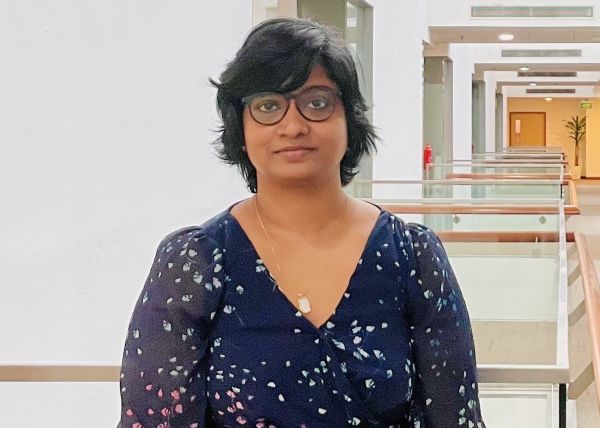
That was the question behind Motor-Mediated Creativity: Bridging Embodied Skill Training and Digital Expression, a project led by SMU Assistant Professor of Computer Science Thivya Kandappu and her team. Their system, MOTUS – Latin for “motion” – takes a different approach to AI in creativity: instead of generating finished artwork, it helps novices develop the motor fluency needed to translate ideas into expressive strokes.
“Creativity isn’t just about the final product,” Professor Kandappu explained. “It’s about the process of exploration. We wanted to see if AI could support that process by scaffolding the embodied skills that make expression possible.”
This is especially true in Singapore, she added, where “the education conversation has been shifting toward creative and adaptive thinking rather than rote mastery.”
Motor-Mediated Creativity was co-authored by SMU School of Computing and Information Systems research engineer Pasindu Bolonghege, PhD student Gevindu Ganganath, Masters student Nipuni Arachchige, as well as senior lecturer Paul Benedict Lincoln of Nanyang Technological University’s National Institute of Education, Singapore.
It was also published at April’s ACM CHI 2026 conference in Barcelona. For the uninitiated, the conference – full name being the Association for Computing Machinery Conference on Human Factors in Computing Systems – is widely regarded as the most prestigious event in the field of Human-Computer Interaction. To reference a recent global event, to be published at ACM CHI is to qualify for the FIFA World Cup.
“It was certainly exciting,” Professor Kandappu told the Office of Research Governance & Administration (ORGA) of the achievement, which she plans to use as a source of motivation.
“[It] reminds me to continue asking important questions of different perspective that has both scientific depth and real-world impact.”
Bridging the expressive gap
MOTUS sought to address an “expressive gap” in digital drawing, which requires a certain mastery of subtle control in pressure, rhythm, and speed – skills that experts acquire over years of practice. Beginners, however, often struggle to make their marks match their intentions, leading to frustration and flat results, the study found.
To kick off the project, 42 participants with no formal visual arts training were put through controlled experiments that tested their motor skills with digital drawing tools. This revealed three core challenges for these novices: “motor control instability; difficulty linking motor actions to intended expressive qualities; and managing competing demands between technique and intended expressive.”
Professor Kandappu’s team then built on these results to design MOTUS, an interactive drawing programme – focusing on a constrained set of strokes – developed in collaboration with professional digital illustrators. These artists, she said, “highlighted that pressure, rhythm, and movement are central to communicating emotion and style, and that these skills develop through practice rather than automation.”
Through MOTUS, motor fluency and creativity were encouraged via embodied prompts. Its efficacy was shown in further tests involving another batch of 36 digital art beginners where, among many other things, these participants developed “rapid gains in movement smoothness” as well as improved “perceived expressiveness”, meaning that they felt that their art “successfully communicated intended emotions”.
Dr. Kandappu is clear that MOTUS was not designed as a productivity tool.
“Our goal wasn’t to help designers work faster,” she said. “[It] was to help people become more expressive by developing motor skills that allow them to translate creative ideas into visual form.”
This distinction matters in an era where generative AI is often seen as a replacement for human creativity, she added.
“Many current AI tools automate output,” she noted. “We deliberately designed MOTUS to support the human creative process rather than replace it.”
The system assumes its feedback will recede over time, as learners internalise motor-expression mappings and develop independence.
“It’s more like a mentor than most AI-for-learning tools out there, which behave like an answer machine that simply gives you the solution,” Professor Kandappu continued.
“MOTUS doesn’t remove the struggle, but calibrates it so the challenge becomes productive and the person, not the system, ends up holding the skill.”
AI-for-learning, not AI learning
What fascinated the researcher was how the project reshaped her view of creativity itself.
“We often think of creativity as having a great idea,” she reflected.
“Through this work I began to see it as the willingness to venture into unfamiliar possibilities, make unexpected movements, and discover something new.”
“This may be just as important as the final outcome.”
That perspective also reframes AI’s role. Instead of asking what tasks AI can automate, the study sought to find out how AI can change the way people learn and explore, “rather than simply optimise”.
While MOTUS is not yet aimed at commercial adoption, its findings point to a new trajectory for creativity support systems – one that values embodied skill cultivation as much as digital functionality.
As Professor Kandappu put it: “The future isn’t about choosing between humans and AI. It’s about designing AI that amplifies uniquely human capabilities. In our case, that capability is expressive creativity.”
Despite promising results, the project sets out its own limitations such as “illustrative rather than exhaustive” stroke work, and “while it covers key primitives (pressure rhythm), it does not capture the full diversity of artistic mark-making.” Also, its participants were restricted to novices, and more expert artists “may require different feedback modalities that support stylistic refinement rather than foundational control”.
Future work, it adds, among other things, should aim to expand such components alongside artists across more genres.
“If AI can encourage people to explore more deeply, reflect more carefully, and gradually become more independent learners, then its impact extends far beyond completing individual tasks,” Professor Kandappu said.
“I think that’s an exciting direction for the future of AI.”
Back to Research@SMU August 2026 Issue
See More News
Want to see more of SMU Research?
Sign up for Research@SMU e-newslettter to know more about our research and research-related events!
If you would like to remove yourself from all our mailing list, please visit https://eservices.smu.edu.sg/internet/DNC/Default.aspx