

By Vince Chong
SMU Office of Research Governance & Administration – In today’s world, more and more businesses are making decisions based on algorithmic-driven artificial intelligence (AI), with human judgment overriding digital recommendations when needed.
This has led to savings in both time and manpower costs, as many retailing giants such as Walmart and Zara have discovered. But can the formula work for enterprises whose pockets that are not necessarily as deep, such as small- to medium-sized convenience stores?
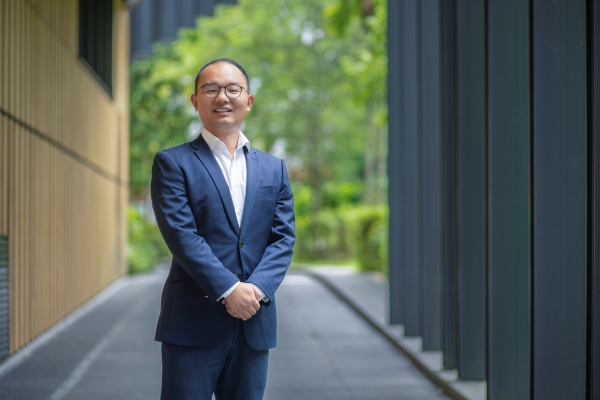
The answer, based on a study by SMU Associate Professor Liang Xu, is simply yes. As Replenishment Recommendation in Convenience Stores demonstrates, “for small retailers without the resources to invest in advanced algorithms,” a simpler, less expensive one can still help them boost efficiency while saving costs.
The research set out to uncover if a similar but less sophisticated AI-led auto replenishment system would work in a mid-sized convenience store chain. What this system did was to take stock of inventory and suggest to store managers what they should be purchasing, a process typically fraught with challenges such as seasonal demand fluctuations, impulse buying and the management of a significant number of slow-moving items that curtail accurate forecasting.
By using this simpler system, managers surveyed in the research used 36.5 percent less time on average to order stock, while improving service levels without extra investment. More importantly, Professor Xu told the Office of Research Governance & Administration (ORGA), it showed how AI can empower people, even amid fears that it can replace human jobs, particularly in industries that typically hire the less educated.
Like the convenience store industry, he noted, where many managers have not been to university, or even finished high school.
“You have one or two people looking after a space of 20 square metres and managing thousands of items catered to not just different seasonality but localities,” he elaborated.
“Add to that high labour turnover exacerbated by long hours and relatively low pay, and you can understand why [such jobs] don’t appeal to most of the educated. And now we have developed an algorithm system that isn’t fancy and doesn’t require a lot of investment. But it empowers those who work in it to manage better.”
Replenishment Recommendation is co-authored by Professor Meng Li, University of Houston, U.S., and Professor Shuming Wang, University of Chinese Academy of Sciences, People’s Republic of China.
Before and after
For their project, the team partnered with a medium-sized convenience store chain in mainland China where each of its stores stocked an extensive variety of some 1,000 different items including “small-packet groceries”, cooked foods, and boxed lunches.
Due to the relatively small scale of convenience stores, the study said, this company could not afford to invest in “sophisticated algorithms tailored to its unique demand patterns and the necessary technology infrastructure.” The average daily sales at each of its stores, the research noted, came to just under 3,000 yuan.
The research team then used the auto replenishment algorithm system across some 20 stores over a period of more than six months in 2019, with store managers using automated recommendations to help them order new stock. Findings include a drastically shorter time spent on ordering inventory, from 72 minutes a day before the system was used, to around 45 minutes after, and an encouraging fall in restocking errors or oversights, which led to less wastage.
Also, while most managers usually made orders in-store so that they could visually track inventory and gauge sales – a difficult task as this was often juggled with other duties such as customer needs or organising – the system allowed them to do it off-site. As the study notes, this made it “less cognitively demanding,” with remote ordering preferred as a “practical and convenient option”. Consequently, most managers chose to place orders from home or during commutes when the system was introduced.
“One thing that fascinated me about this research was that I didn’t think store managers would welcome the system, given the perception that this might be something that could replace them,” Professor Xu said.
“As it turned out, it was quite the opposite. They liked it a lot as it freed them from ordering [tasks], which took them on average 1.5 hours to two hours a day. Instead they could spend more time on talking to customers, cleaning shelves, organising inventory, etc.”
What is also certain, the research shows, was that human judgment remained very much necessary, with store managers deviating from algorithmic recommendations for reasons such as heatwave, which would see them order more beverages.
“Furthermore, the system may not fully capture the unique preferences of their local customer base, particularly for items that were top sellers in specific stores but not necessarily across the entire chain,” the research report added. This would include outlets in business districts, for example, which frequently cater to large purchases of certain snacks and drinks for corporate events.
“Automation vs. Augmentation”
Moreover, as online retailer Amazon found out, it is harder said than done trying to run an entire store operation via algorithm alone. As a report noted in 2024, the company’s Just Walk Out cashier-less supermarkets relied in fact on some 1,000 remote contractors to work, even though it was supposed to be fully automated.
As Professor Xu noted, the technology “just isn’t there yet” for operations such as convenience or retail stores to be run entirely by AI. More importantly, his study suggests that complete automation may not be the most productive goal. Instead, businesses should seek to use algorithms in specific tasks where they perform better. In short, work can be redesigned so that people and technology complement one another.
“In our setting, the algorithm does what computers are good at: it scans inventory across thousands of items, identifies historical demand patterns and pre-fills a recommended ordering quantity,” Professor Xu explained.
“The manager then focuses on what the system cannot easily observe – unusual local demand, weather events, delivery constraints, labour availability and other exceptions.”
This is not simply automation; it is augmentation, he continued.
“A human-centred, human-in-the-loop system is a more practical and humane way of introducing AI,” Professor Xu said.
“The objective is not to remove people from the business, but to give them better tools, reduce unnecessary burdens and allow them to concentrate on the work where they create the greatest value.”
Back to Research@SMU August 2026 Issue
See More News

Want to see more of SMU Research?
Sign up for Research@SMU e-newslettter to know more about our research and research-related events!
If you would like to remove yourself from all our mailing list, please visit https://eservices.smu.edu.sg/internet/DNC/Default.aspx