

By Christie Loh
SMU Office of Research Governance & Administration – It should have been like any other day in the condominium gym, with just the familiar hum of treadmills and weights machines during her daily workout. But there were invaders that morning. Her neighbour had brought in a zealous personal trainer, so the usually quiet room was booming with ‘You can do it!’s and the inevitably audible huffing and puffing.
Ears ringing from the din, Professor of Sociology Paulin Straughan would have been justified in feeling even a little irritation. Yet she chose to respond with friendship and serenity. “What to do… We are friends so we can’t complain,” she sighed.
Professor Straughan, a prominent sociologist at Singapore Management University (SMU), has a disarming manner of peppering conversations with personal anecdotes linked to observations about society. And when she recounted the gym incident that had occurred just hours before her interview with SMU’s Office of Research Governance and Administration (ORGA), she had a point to make: Friends can break down barriers, lessen hostility and, in Singapore’s drive towards productive longevity, push each other to adopt healthier lifestyles. The ripple effect can be immense, especially if the social and built environments are designed to amplify community interactions.
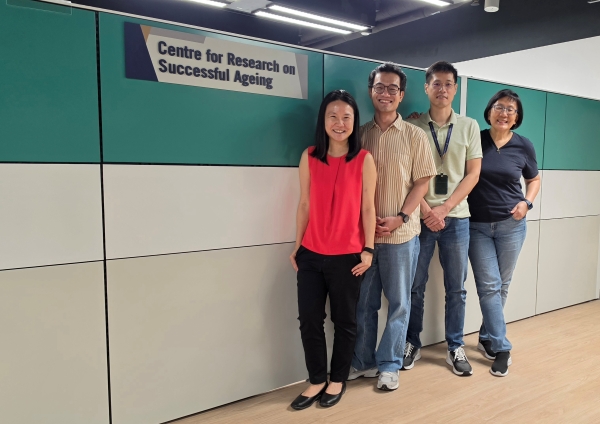
Studying how to create such conducive environments is now occupying SMU’s Centre for Research on Successful Ageing (ROSA), where Professor Straughan is Director. Her proposal to examine “Societal Nudges to Promote Well-being of a Super-aged Population” recently secured ROSA a second round of funding over the next five years from the Ministry of Education’s Academic Research Fund (AcRF) Tier 3 grant.
Nudges and lively neighbourhoods
Singapore is a newly minted ‘super-aged” society, as the proportion of its population aged 65 and above has hit one-fifth. This fraction is estimated to expand to one-quarter within just four years by 2030.
Rather than regard this senior segment as “people who are just waiting to die”, Professor Straughan hopes the public will start to view ageing as a productive stage of life through community participation. “This will help us to retain the talent that we have, where seniors learn how to transform to become social assets in the community,” she said.
To that end, her research team will study how urban design and infrastructure influence physical activity, mobility, and social participation among older adults. “I would like to see us learn how to build infrastructure with a purpose beyond aesthetics, particularly how to build Third Places intentionally,” she said. The “Third Place” is a sociological term describing physical settings that encourage informal social interaction, such as cafes, aside from one’s home and workplace.
Hawker centres, for instance, could become community kitchens, said Professor Straughan, who plans to work on such a project with the relevant government agencies.
“These spaces will be alive with programmes and social events that will naturally draw people in. Then the messaging on health and wellbeing can be embedded. And because so many people are involved, it will start to change norms,” she said.
The research team will analyse how social settings and the built environment can systematically “nudge” people to willingly adopt pro-health behaviours, as it is a more sustainable approach to wellbeing-management versus ‘coercive’ methods such as an outright ban on sugary drinks.
Ultimately, it is community spirit that will help Singapore thrive in its super-aged status, Professor Straughan believes, because household sizes are shrinking and elder care can no longer be the sole domain of one’s immediate family. “We need to redefine who family is,” she said.
“When we have neighbourhoods that are alive with connections and high social capital, then we look after each other. We will leave the State to look after those who are ultra poor and need state intervention.”
Merging SLP data with MOH TRUST
A core function of ROSA is the maintenance of the Singapore Life Panel (SLP), the world’s largest high-frequency longitudinal survey on ageing since its launch in 2015. It yields some 7,500 responses monthly from Singapore residents aged 50-80, capturing significant trajectories of the country’s changing demographics.
To enhance the SLP’s credibility, ROSA will be linking SLP data – which is self-reported by respondents and hence, subjective – with the Ministry of Health’s (MOH) TRUST platform, which collates anonymised health-related research and objective real-world data, and is accessible only to vetted researchers.
“When merged with administrative data, the SLP constitutes a nationally significant dataset that supports holistic, cross-cohort, and policy-relevant ageing research,” Professor Straughan wrote in her proposal.
She is visibly passionate when it comes to the ROSA team, which maintains the SLP and cultivates contacts for the longitudinal panel.
“We have built a very strong team in the centre,” she said. “But I do think that for us to sustain, we also must have the University to support the manpower because we cannot be flushing people out every time the grant is over. It’s the core research team that maintains the SLP. Somebody has to continue to do the hard work. Here is where support from University is very important.”
Nudge, nudge.
Back to Research@SMU August 2026 Issue
See More News
Want to see more of SMU Research?
Sign up for Research@SMU e-newslettter to know more about our research and research-related events!
If you would like to remove yourself from all our mailing list, please visit https://eservices.smu.edu.sg/internet/DNC/Default.aspx