

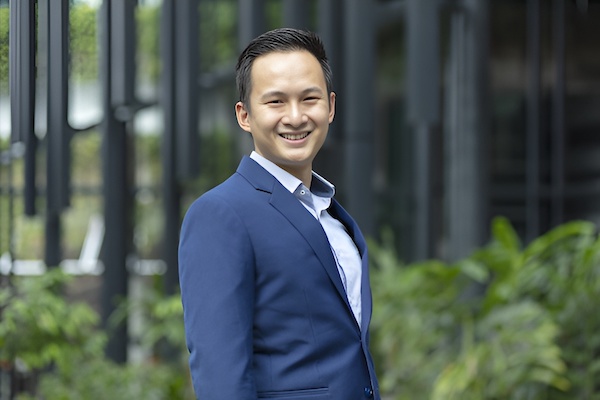
By Vince Chong
SMU Office of Research Governance & Administration – While Singapore has prospered over the years – median monthly household income rose to S$12,446 in 2025 from S$8,839 in 2015 – there remains a segment living in public rental flats who have not been similarly uplifted.
Surprisingly, what is essentially short-term housing has been used by some families for as many as three generations – a key observation that has driven SMU Assistant Professor Nathan Peng to find out more.
The result is Understanding Intergenerational Mobility Among Public Rental Flat Residents, a project that has been awarded the Social Mobility Foundation Grant from the Lee Kuan Yew School of Public Policy at the National University of Singapore, for its potential to generate actionable insights.
The ongoing one-year study seeks to understand the state of intergenerational mobility among some 52,000 public rental households, Professor Peng told the Office of Research Governance & Administration (ORGA).
These are families that earn an average household income of roughly S$1,500 per month, he said, and living in public rental homes that range from partitioned flats for singles, to one- and two-room units.
“It is puzzling, to say the least, that some of these households have been there for a long time, when public rental homes are meant solely to help them stabilise their situation and get help so that they can buy their own flat at some point,” Professor Peng said.
“But paradoxically, many appear quite happy with the system, which may reduce their likelihood of moving up socially.”
Public rental is no longer a short-term solution, he added. As his research proposal set out, the goal of its findings is to ultimately “inform initiatives that attempt to lift this most vulnerable group in Singapore out of the poverty trap and break the intergenerational transmission of vulnerability.”
Collaborating on Understanding Intergenerational Mobility is SMU Associate Professor Jacinth Tan, who brings invaluable perspectives from social psychology on how subjective beliefs and perceptions might be driving some of the observed behaviours.
Breaking with reality
The study is expected to run for 12 months between May 2026 and April 2027, excluding initial investigations that were conducted between January and April 2026. Professor Peng’s earlier observations stemmed from the findings of these latter in-depth interviews that covered roughly 180 survey respondents.
The project team is now building the insights from this pilot exercise into the instruments for the next phase, which will similarly include surveys and face-to-face interviews with potential respondents recruited from the 26 rental housing regions across all unit types. Ex-public rental residents will also be contacted where possible to “provide factors behind their successful transition.” Residents who are staying there with their children will be prioritised given the focus on intergenerational mobility, Professor Peng said.
The research, according to its proposal, is based on a preliminary theoretical framework not unlike “Brownian motion where particles suspended in a fluid appear to move erratically because of continuous collisions with the unseen particles of the fluid.” This refers in the project to how the decisions of lower income groups on “where to invest their efforts follow clear, but sometimes unseen (or unknown) logics.”
One such example taken from the initial interviews, Professor Peng noted, was the sense of “generational guilt” that parents in these households felt: they recall their own negative experiences growing up, and so avoid exerting pressure on their children.
“They might believe that they did not have happy childhoods, and so they don’t want to push their kids academically, to do better, as long as they’re happy,” he explained.
“As a parent, I completely understand and appreciate their desire for their child to lead stress-free and happy lives. But from the research, this needs to be balanced against having a certain healthy level of expectations for your children to show that we believe in their ability to do better so they strive towards achieving their full potential.”
Also surprising, he continued, was how some public rental residents saw themselves as being middle- or even high-income households. As his initial research found, 43% of interviewees thought themselves part of the middle quintile of household income – meaning the 41-60% income segment of the entire population – while 51% saw themselves there in the future, a period that was not yet defined.
Where their children were concerned, 45%, 35% and 8% of residents believed they would be in the middle, upper and highest quintile, respectively.
“What hit me viscerally was not just this break with the entry criteria for public rental housing, but also that many of these residents – too many for the findings to be a[n inconsequential] blip – were genuinely satisfied and optimistic,” Professor Peng said.
“This by itself isn’t a bad thing, but they did not come across as wanting to move out of public rental housing, which by definition is reserved for statistically the poorest part of the population.”
Shifting opportunities, silver lining
Exacerbating the difficulties of social mobility for the less privileged, he continued, is the increasing speed at which life is moving in general.
“Now we are in an age of AI [artificial intelligence] proliferation, where opportunities are shifting even faster than when the internet first appeared perhaps three decades ago,” Professor Peng elaborated. This is a sentiment echoed recently by Singapore Prime Minister Lawrence Wong when discussing how AI might replace routine work that is vital training for young and new staff.
“Jobs are being displaced, industries are being disrupted and for those lower down the social ladder, this speed of change is making it even more difficult for the next generation to catch up to their peers,” Professor Peng went on.
For example, he said, those who can pay turn to the private sector either for education or sports courses for their children or themselves, so as to stay relevant or simply to catch up. This is almost never an option for those in public rental housing.
And while the informal adage of hard work reaping rewards rings generally true in the past, the numbers reflect a shifting reality.
Professor Peng cited the Singapore Ministry of Finance’s Occasional Paper on Income Growth, Inequality, and Social Mobility Trends in Singapore, released earlier this year, which showed that those born in the late 80s have their income levels more tied to their parents’ incomes.
“This means that the odds of children born to the lowest 20% [of population in terms of household income] to make it to the top 20% might be coming down,” he said.
“Going forward, I fear it will be even more difficult.”
On the bright side, he added, in Singapore at least, policymakers and stakeholders in either the public or private sectors are well aware of the situation, and taking steps to correct it. Programmes like KidSTART, he noted, can “help to hopefully provide lower-income parents with the support they need to close the developmental gap that arise from diverging family resources.”
“I was motivated to dig deeper into this issue firstly from what I was hearing from frontline experts, the social workers, civil servants,” Professor Peng said.
“What we are seeing now is that this inequality is posing a unique problem because what was supposed to be a short-term solution is no longer one. Hopefully this research will help us understand why.”
Back to Research@SMU November 2026 Issue
See More News
Want to see more of SMU Research?
Sign up for Research@SMU e-newslettter to know more about our research and research-related events!
If you would like to remove yourself from all our mailing list, please visit https://eservices.smu.edu.sg/internet/DNC/Default.aspx